
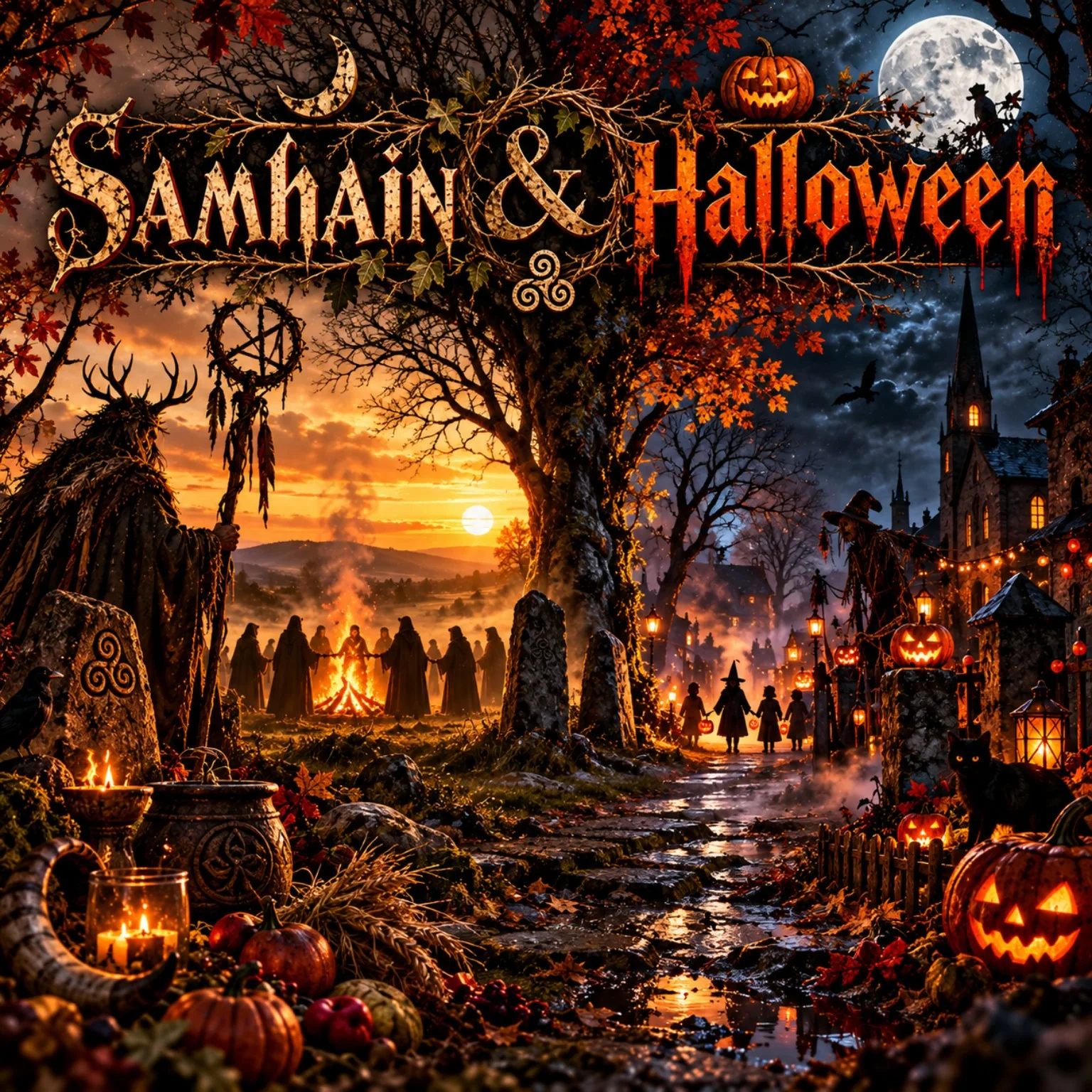
Samhain
Samhain is a Celtic pagan festival to mark the end of the harvest season and the beginning of Winter. It is also a time of reflection, when our ancestors return from beyond the veil to live and feast amongst us once again.
Tables often had empty settings with seats, plates and cups and an offering of food and wine for the wandering souls. It was a superstition that you never refused anyone who would knock on your door on Samhain, you never knew if they were a living person or one of these wandering souls from the other side.
The occasion was marked with a celebration on October 31st. People would gather to feast and drink, light bonfires, and welcome the spirits back to celebrate the end of another harvest and the "death" of the Sun in the hopes of its "rebirth" and return in Spring.
In old Ireland, Samhain was not considered a night to be wandering lonely roads after sunset. It was believed that as the veil between worlds grew thin, ancient paths, crossroads and forgotten places belonged as much to the Otherworld as they did to the living. The wise often stayed close to the warmth and safety of the fire until morning.
Who might you meet on Samhain night?
In Irish history and folklore you could meet any number of entities on Samhain night. If you were lucky, you might meet the spirits of your own relatives who had come back to celebrate with you.
Other mischievous and dark entities you might have the misfortune of meeting are the Púca, the Death Coach, spirits from Purgatory, the Black Dog or the Fairies, often referred to as "The Good People" by locals.
The Púca was one of the most feared creatures of Irish folklore. Said to appear as a black horse, goat or hound, it wandered the countryside after dark. Some stories claimed encounters with the Púca brought good fortune, while others warned it delighted in leading travellers astray or carrying them on terrifying rides through the night.
Then there was the Coiste Bodhar, the Death Coach. Drawn by dark horses and carrying the souls of those soon to leave this world, the coach was said to travel lonely roads and country lanes after nightfall. If you heard a voice calling your name from outside on Samhain night, old superstition warned never to answer.
Many people also feared crossing paths with the fairies. Samhain was believed to be one of the times when the doors to the Otherworld stood open, allowing The Good People to move freely between their realm and ours. Offerings of food were sometimes left outside homes, not as gifts, but as a precaution. Few wished to offend such powerful neighbours.
Bonefires "Bonfire"
In ancient times animals and livestock were a symbol of wealth. Animal bones were thrown onto these fires to ward off evil spirits and to usher in health and good fortune in the coming dark Winter months.
The ashes from these fires were collected and spread over the land to protect against any evil spirits who might come to destroy crops and kill livestock.
Once the celebrations came to an end, families would often carry embers from the communal bonfire back to their own homes. Their household fires would then be relit using the sacred flame, bringing protection, warmth and blessings into the Winter months ahead.
Dressing up
Our ancestors were not the only entities you might meet on a Samhain night, as the veil between our world and the next grew thinner it allowed both good and evil spirits to cross to this side.
Out of fear of being recognised by one of those evil spirits, people wore disguises to trick and ward off spirits.
Some travellers would even turn their coats inside out before heading home after dark, believing the strange practice would confuse any spirit that might attempt to follow them.
Trick or Treat
Trick or treating evolved from the custom of people leaving food offerings to appease spirits on Samhain night.
In medieval England and Ireland, children would go "souling" on All Hallows' Eve, visiting homes to sing prayers for the deceased in exchange for soul cakes.
Over time, these customs evolved and blended with local traditions, eventually becoming the trick or treating we know today.
Carved Lanterns
In Celtic Ireland, people would carve scary faces out of turnips to frighten away evil spirits and entities.
These lanterns were often placed in windows and doorways to guard the household against anything unwanted wandering in from the darkness beyond.
When Irish immigrants moved to the U.S.A, they began carving jack o' lanterns from pumpkins, as these were native to the region and easier to carve than a turnip.
Jack o' Lantern came from a character called "Stingy Jack" who was said to be a miserable old drunk who loved playing tricks on anyone and everyone, even the devil himself.
The story goes that after tricking the devil not to take his soul, God denied Jack a place in Heaven and, true to his word, the Devil did not take Jack into Hell.
However, he instead cursed Jack to endlessly wander the night with only a burning coal to light his way. Jack then made a makeshift lantern out of a carved turnip and placed the coal inside.
And so, according to legend, Stingy Jack still wanders the darkness, searching for a place where he may finally rest.
Traditional games on Samhain night
Divination and trying to tell the future was part of the festivities. For example, if you had a couple hoping to be married, each would throw a hazelnut into the fire. If they jumped towards each other it was seen as a good omen of a happy marriage. If the nuts jumped away from each other, well, this would indicate that it was not a perfect match.
Apples were also linked with fortune telling. One tradition involved peeling an apple in a single strip and throwing the peel over your shoulder. The shape it formed on the ground was believed to reveal the first letter of your future husband or wife.
Bobbing for apples was another, if not messy, tradition. Children would gather around a bucket or basin filled with water and apples. With your hands behind your back, you had to dunk your head into the bucket and retrieve an apple using only your teeth.
Apples were also hung from string and would-be contestants would try to take a bite out of the apple in order to win.
Whether the predictions came true or not, these games were a welcome distraction during a night when many believed the supernatural world was closer than ever.
Halloween
As the years went by, and as more cultures influenced and adopted Samhain, it was reinvented into the modern-day holiday we all know and love as Halloween.
Although today's celebrations are often filled with costumes, sweets and parties, echoes of the old traditions still remain. The carved lanterns, the disguises, the gathering of family and friends and even the stories told late into the night can all trace their roots back to those ancient Autumn celebrations.
Wherever you are, I wish you a night filled with joy and laughter with your friends and your family.
Just remember one thing.
When you are ready to settle down for the night, before going to bed, check under your bed, behind your curtains and in your wardrobes.
Make sure when you lock your front door that you are indeed not locking anything inside with you.
Blessed Samhain & Happy Halloween