
History
In the shadowy forests of Germany’s Palatinate region, long before Santa Claus’s sleigh bells reached every chimney, a very different kind of winter visitor appeared at doors in December: Belsnickel.
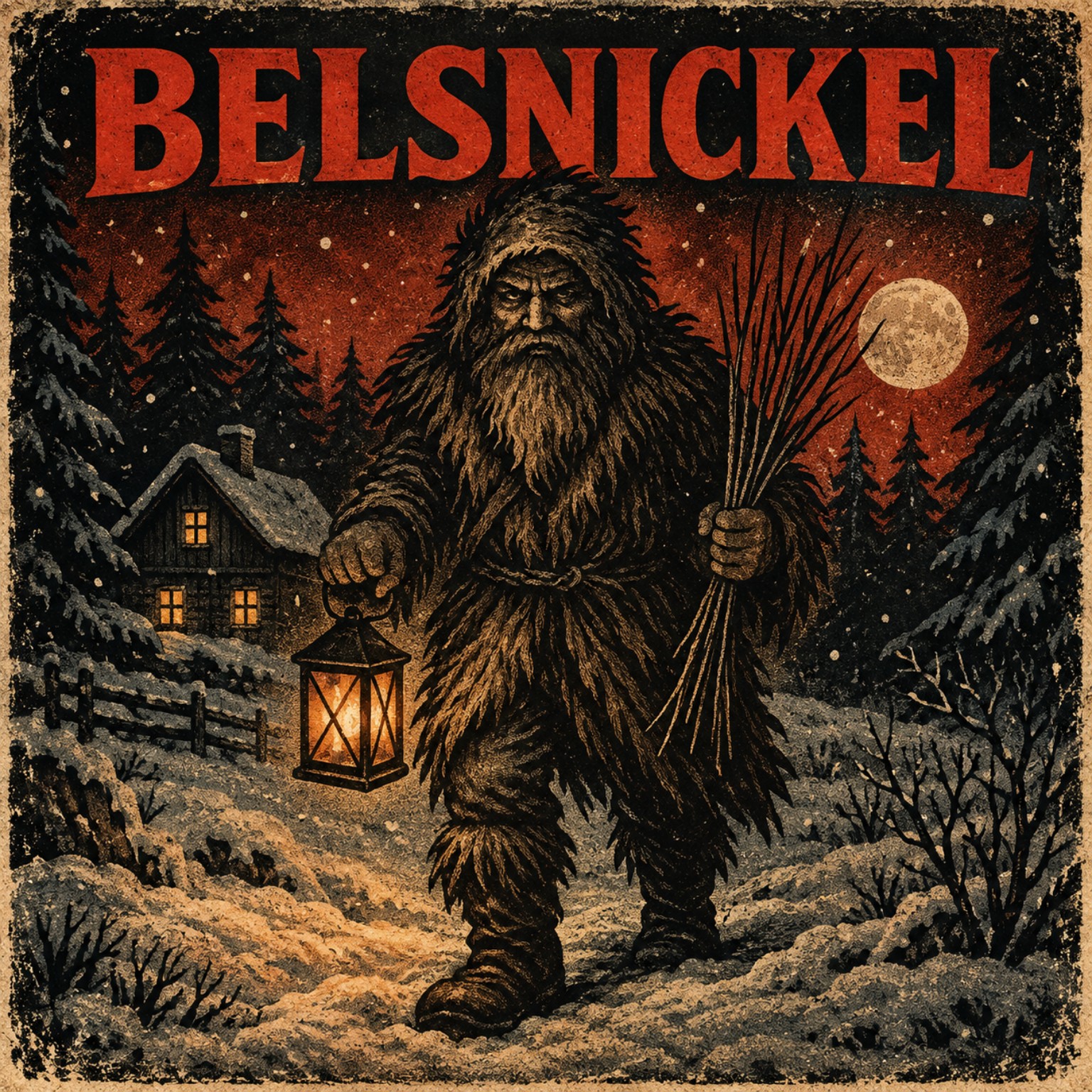
His name likely comes from “Pelz-Nickel” or “Bels-Nickel,” meaning “Fur Nicholas.” Unlike Saint Nicholas, with his bishop’s mitre and blessings, Belsnickel was a gritty, solitary figure wrapped in animal pelts, tattered robes, and soot. He carried a bag of treats in one hand and a switch of birch branches in the other, wandering from house to house in the weeks before Christmas.
The tradition spread with German immigrants to Pennsylvania in the 18th and 19th centuries, where it flourished among Pennsylvania Dutch communities. There, Belsnickel became a uniquely American winter boogeyman: still fur-clad, still judgemental, but now knocking on farmhouse doors in the dark December evenings, a lantern flickering beside him.
Folklore & Legend
Belsnickel arrives alone, not with a merry entourage. He’s a liminal figure, part gift-giver, part punisher, and entirely unpredictable.
He typically comes one or two weeks before Christmas, knocking loudly on doors or rattling windows, his voice gruff, his boots stomping snow off the porch. When the door opens, children find a wild, soot-streaked figure, face often hidden by a mask or scarf, fur and rags hanging in strips, sometimes crowned with antlers or ivy.
He steps inside and tests the children. In some regions, he demands they recite prayers, sing songs, or promise good behaviour. Good children receive sweets, nuts, or gingerbread tossed onto the floor. The catch? While the children scramble to gather the treats, Belsnickel watches, and those who are greedy or disrespectful get a swift crack of the switch across their legs or hands.
This dual nature is what makes Belsnickel so compelling. He’s neither saint nor monster. He’s human enough to enter through the door, sit by the fire, and talk to the children… but strange enough to unsettle even adults. His presence was meant to keep children morally sharp in the lead-up to Christmas, not through pure fear, but through the uneasy sense that someone is watching, and that someone is not entirely predictable.
Paranormal Aftermath
Though Belsnickel has largely faded from mainstream Christmas celebrations, his legend persists in rural corners of Pennsylvania and Germany, where Belsnickeling, groups dressing as the figure and visiting homes, still happens. It’s part revelry, part performance, part lingering folk ritual.
Some families tell stories of hearing knocks on their windows in early December, followed by the faint sound of boots crunching snow, though no one is ever there. Others swear they’ve seen a lone lantern bobbing between the trees near farmhouses on cold nights, moving too steadily to be windblown but too eerily to be normal.
In a few communities, people leave small offerings of schnapps or sweets by the door in early December, not for Santa, but for Belsnickel, in case the old, fur-clad wanderer still makes his rounds.
What makes Belsnickel so unnerving is how close to human he remains. He isn’t a horned beast, nor a spectral witch. He’s a man, or something that wears the shape of one, knocking at your door in the dead of winter, judging you by the firelight. A rustic conscience made flesh.
He is the gritty ghost of Christmas past, a living reminder that winter once belonged to the forests and to figures who carried both reward and reckoning in their sacks. When Belsnickel knocks, you’d best have your manners ready.