
History
In the early 18th century, Edinburgh was a city on edge. Poverty, unrest, and resentment toward authority simmered in the closes and wynds of the Old Town. Into this world stepped Captain John Porteous, commander of the Edinburgh City Guard.
The City Guard was a kind of local militia tasked with keeping order, but in practice they were feared and hated by much of the population. Porteous himself was known as a stern, often brutal officer, proud, quick-tempered, and harsh in his judgments.
In April 1736, events came to a head. A smuggler named Andrew Wilson, popular among the poor for his defiance of taxes, was executed in the Grassmarket. The crowd that gathered was restless and hostile. When stones were thrown, Porteous ordered his men to fire into the crowd. Several innocent people were killed, including bystanders who weren’t even part of the protest. The city was outraged.
Porteous was arrested, tried for murder, and sentenced to hang. Yet political connections worked in his favor. At the last moment, whispers spread that he had been granted a royal pardon.
The people of Edinburgh had had enough.
Folklore & Legend
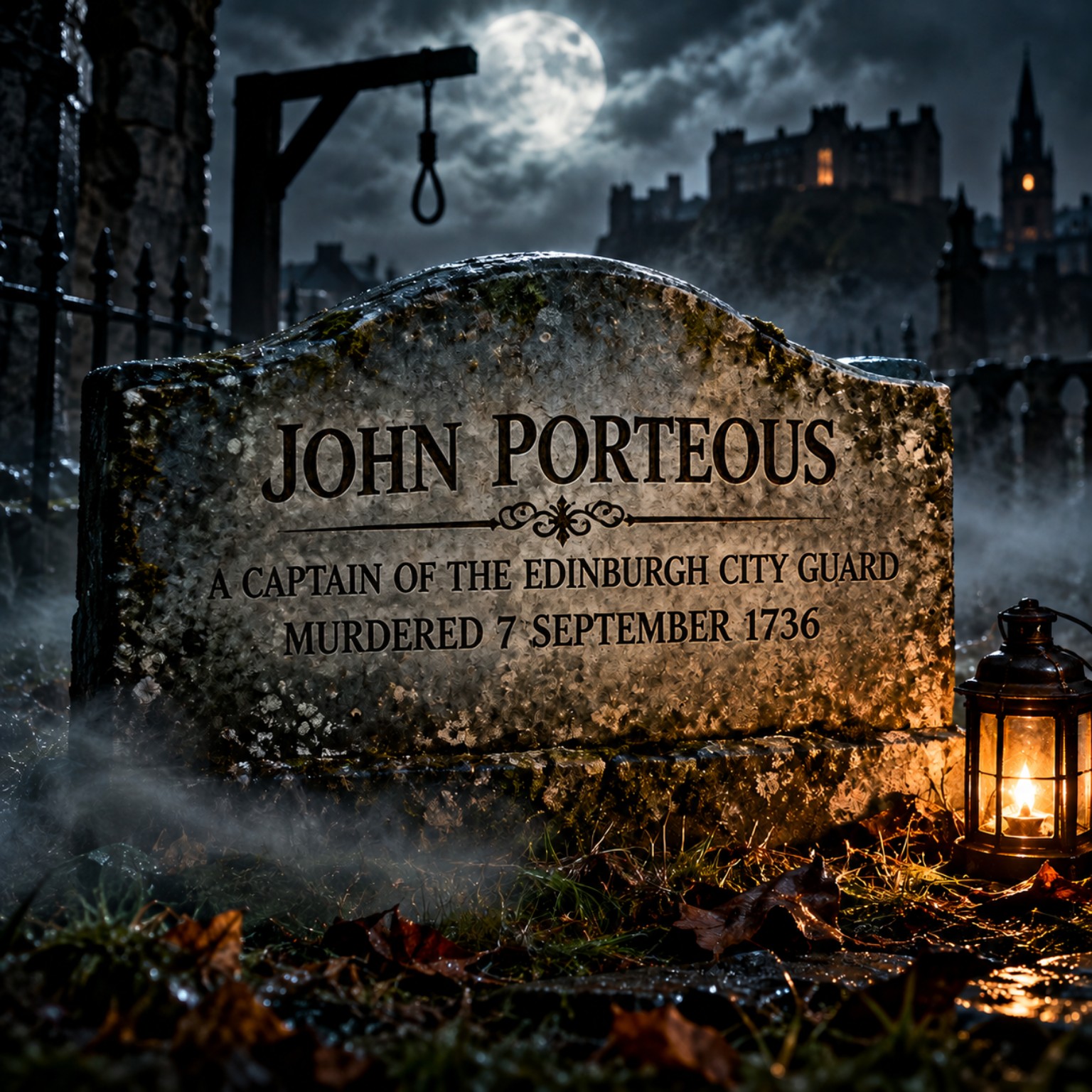
On the night of 7 September 1736, an enraged mob gathered. Ordinary citizens, masked and armed with staves, surged through the Old Town. They stormed the Tolbooth prison at Parliament Square, overpowered the guards, and dragged Captain Porteous into the streets.
He was hauled through the wynds and closes, begging for mercy as the mob jeered. They brought him to the Grassmarket, the very place where Andrew Wilson had died and where Porteous had ordered his soldiers to fire. There, beneath the looming gallows, justice was taken into the people’s own hands.
They strung him up on a dyer’s pole. Twice the rope broke. Twice he fell back into the dirt. Each time the mob tightened another rope and raised him again. Finally, he was hanged until dead, his body left swinging in the night air.
The Crown and the city elite were horrified, but the deed was done. No one in the mob was ever truly punished. For the people of Edinburgh, it was rough justice, and Porteous’s name was blackened forever.
From then on, stories of Porteous’s restless ghost began to grow. Some said his soul could not rest, condemned to relive his trial and execution over and over in Edinburgh’s narrow closes. Others swore his boots could be heard striking stone in the Grassmarket long after midnight.
Paranormal Aftermath
The Grassmarket is now one of the liveliest districts in Edinburgh, with pubs and cafés, but many say the ground remembers. Guides tell of phantom footsteps pacing near the execution spot. Tourists have reported the sensation of choking or pressure on the throat while standing by the old gallows’ site.
In the closes near the old Tolbooth, eerie presences are felt. Witnesses describe hearing a man’s desperate cries, or the jangle of iron keys echoing from nowhere. Some paranormal investigators claim to have captured disembodied shouts, curses and cries of rage, believed to be the voice of Captain Porteous himself.
Even today, the story is woven into Edinburgh’s haunted tours. Some say that when the wind whips through the Grassmarket on a September evening, you might hear a faint rope creaking, as though a man still swings there, condemned not by court but by the people.