
The Winter Enforcer of Yuletide Morality
High in the Alpine regions of Austria and Southern Germany, where winter presses close like a heavy woollen cloak and the nights stretch long, Frau Perchta prowls. Her name drifts through snow-laden air like a warning, whispered by mothers to their children when the hearthfire burns low.
Her legend predates Christianity, rooted in ancient Alpine paganism. Scholars trace her origins to a pre-Christian winter goddess, possibly linked to Berchta or Perhta, a figure associated with the wild hunt, spinning, and the turning of the year. She was once a guardian of the domestic sphere, watching over spinning wheels and household order during the darkest season.
When Christianity took hold, Frau Perchta was not erased, but transformed. Her divine authority became a stern, spectral presence, stalking the Twelve Nights of Christmas, from December twenty-fifth to January sixth. These were liminal days, believed to exist outside normal time, when spirits roamed freely and the veil between worlds thinned. It is during these nights that she makes her rounds, moving silently from house to house, judging who has honoured the old customs and who has not.
Folklore and Legend
Frau Perchta is no kindly gift-giver. While Saint Nicholas rewards good children and Krampus punishes with lashes, she takes things much further.
The stories tell that she enters homes at night, sometimes through a window, sometimes simply appearing by the hearth. She checks whether the housework has been done, especially spinning. In older times, wool spinning was meant to be finished by the Twelfth Night, and Frau Perchta would not tolerate idleness.
If she found industrious children and tidy homes, she would leave a silver coin in a shoe or on the table, a quiet reward. But for the lazy, the greedy, or the dishonest, her justice was visceral. She would slice open their bellies, remove their organs, stuff the cavity with straw and pebbles, and stitch them back up with icy precision. This horrifying act was not mere cruelty, but symbolic punishment for spiritual sloth, stuffing the belly with what is empty, useless, and cold.
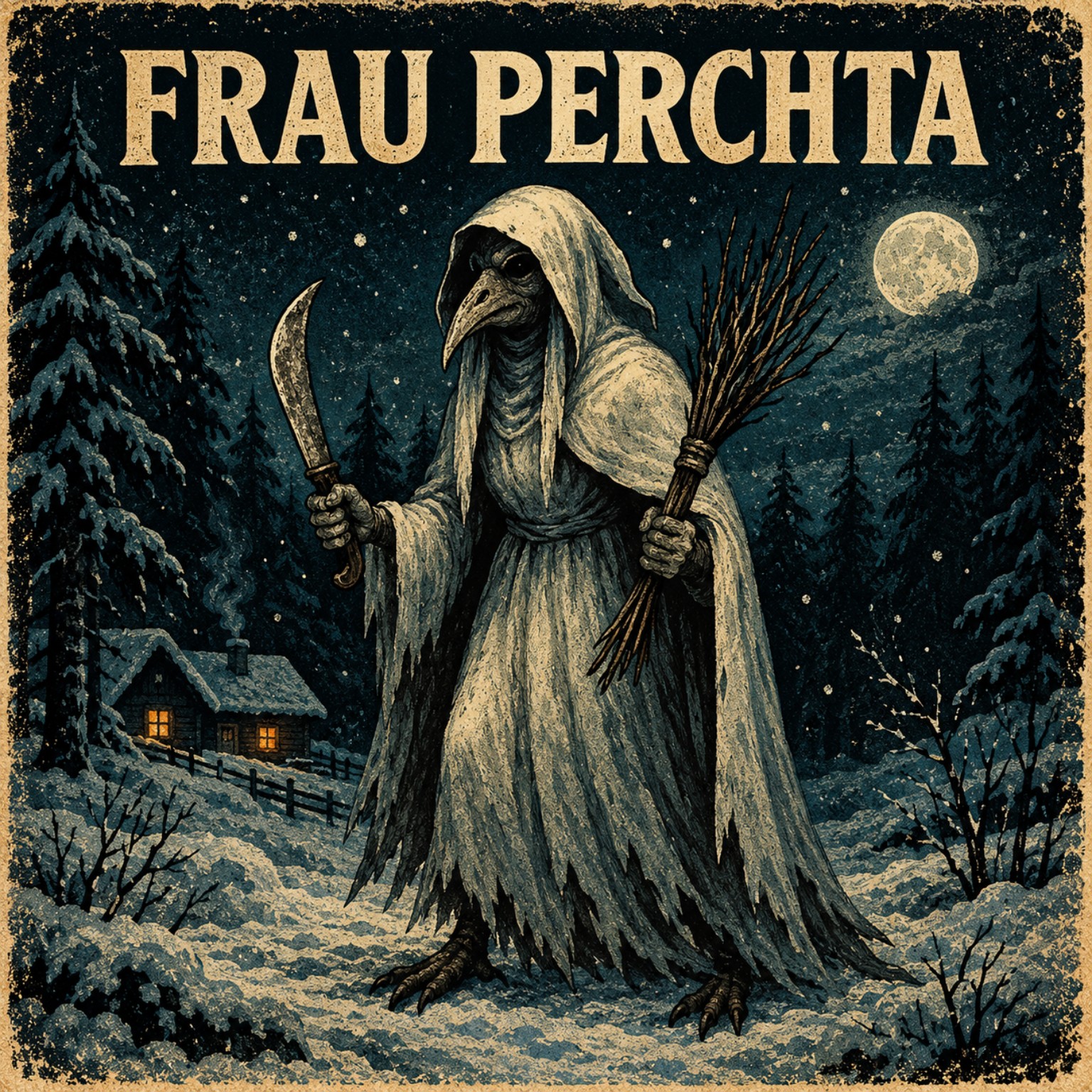
She is often depicted as a strange, spectral figure, draped in white, wearing a beaked mask reminiscent of a bird of omen, with goose feet poking out from beneath her gown, markings of her otherworldly nature. Sometimes she leads a wild procession known as the Perchtenlauf. In these parades, masked figures, some beautiful, some monstrous, storm through the streets ringing bells and cracking whips to drive out winter’s darkness. The beautiful Perchten bring blessings. The ugly Perchten embody the darker, more chaotic spirits she commands.
Paranormal Aftermath
Though the Church once tried to suppress her legend, Frau Perchta endures. In modern Alpine villages, the Perchtenlauf festivals remain a haunting spectacle. Men in horned masks and shaggy pelts thunder down cobbled streets carrying torches, cowbells, and switches. The air fills with smoke, snow, and the primal sound of bells, half celebration, half exorcism.
Some villagers claim that in the deepest winter nights, away from the festival lights, a tall figure has been seen gliding across the snow near barns and old houses. Her robes are pale against the black treeline. Her face is long and strange, bird-like. Dogs howl without reason. Windows frost over from the inside.
A few chilling stories tell of households where unexplained straw was found strewn across beds or floors during the Twelve Nights. No footprints in the snow. No intruders. Just straw, as though something, or someone, had quietly inspected the home while the world slept.
To this day, in rural parts of Austria, some families cover mirrors, tidy the spinning rooms, and keep fires burning through the long nights, not merely for warmth, but to ward off her gaze. Frau Perchta is more than a myth. She is the embodiment of winter’s moral edge, the cold justice that lurks between one year and the next.
She is winter’s quiet judge. Neither saint nor devil. Neither wholly goddess nor ghost. She comes not with sleigh bells or songs, but with goose feet crunching in the snow and a knife’s cold gleam by firelight.
Reflection
If she came to your door tonight, would your home be ready, your work complete, your spirit in order?