
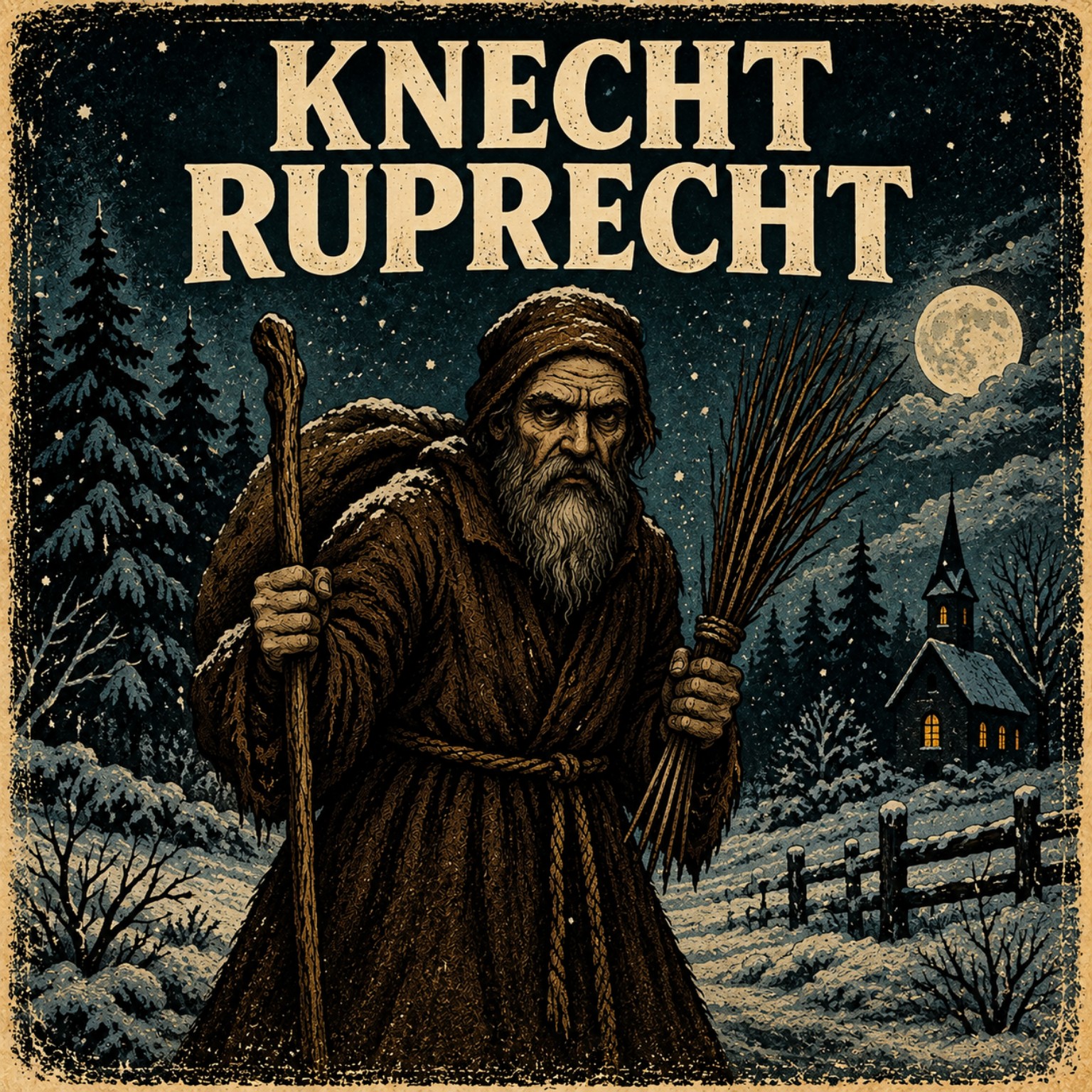
The Winter Examiner of Souls
In the snow-blanketed heartlands of Germany, when the wind howls down the chimneys and the bells of Advent toll through the frost, a strange pair walks the winter roads. At the front is Saint Nicholas, the benevolent bishop bearing gifts and blessings. At his side, in stark contrast, walks Knecht Ruprecht, known as Farmhand Rupert, cloaked in darkness, staff in hand, soot on his face, and a stern gaze that has unsettled children for centuries.
His origins are tangled, as most winter spirits are. Some say he was once a mortal servant of Saint Nicholas, a pious man who followed the bishop on his rounds. Others claim he is a tamed forest spirit, drawn into Christian tradition as a shadowy helper. His name, Ruprecht, is linked to the Old High German word Hruodperaht, meaning fame-bright, a name sometimes associated with ancient deities like Wodan, or Odin, suggesting that Ruprecht may be an echo of an older god, pressed into the service of the Church.
Whatever his beginnings, by the seventeenth century his image had hardened. He became a tall, thin, bearded man in a long, dark robe, carrying a staff or switch and a sack of treats or coal. Where Saint Nicholas brings joy, Ruprecht brings inspection.
Folklore and Legend
Knecht Ruprecht’s role is clear. He tests the children.
When Nicholas arrives at a home, Ruprecht steps forward first. He does not shower children with gifts. Instead, he asks a single question.
Have you said your prayers?
If the child can answer well, reciting their prayers and proving their good conduct, they receive sweets, apples, and nuts. But if the answer falters, or their behaviour has been less than saintly, Ruprecht’s switch comes out. In some regions, he delivers a beating. In others, he leaves coal, stones, or simply walks away in silence, a judgement colder than the winter air.
Older versions of the legend are even darker. Some tales say Ruprecht carries a sack or basket on his back for spiriting away particularly naughty children, taking them to forests or rivers where their fates are left ambiguous. He is not a roaring demon like Krampus, nor a wildman like Hans Trapp. He is worse in some ways, calm, methodical, quietly terrifying.
Ruprecht is also tied to old midwinter traditions of processions, where groups would dress as Nicholas and Ruprecht and visit homes, enacting the ritual of moral accounting. In these plays, Nicholas represented mercy, while Ruprecht embodied justice and consequence, a kind of supernatural balance sheet of the soul.
Paranormal Aftermath
In modern Germany, Knecht Ruprecht is less visible than his jollier counterpart, but he has not vanished. Some regions still include him in Saint Nicholas Day processions on December fifth or sixth. A tall man in dark robes, soot on his face, staff in hand, follows the bishop through snowy streets. Children, dressed in their best, line up nervously, half thrilled, half fearful.
There are whispers, too, from rural households near forested villages. Strange staff-like tapping on windows at night during the first week of December. Ash footprints left on thresholds. The smell of smoke and cold iron in rooms with closed chimneys. Some families still leave little bowls of porridge or apples near the hearth, not for Nicholas, but for Ruprecht, to keep him appeased.
In older farmsteads, elders say that if you lie awake on December fifth, you might hear two sets of footsteps passing outside. One is light and rhythmic, like a bishop’s. The other is heavier and deliberate, the echo of a farmhand who never quite belonged in heaven or hell.
Knecht Ruprecht is not a figure of wild punishment or fiery damnation. He is winter’s interrogator. He asks questions that only the guilty fear. And when he walks beside Nicholas, he reminds everyone that kindness and judgement arrive hand in hand.
He is the quiet shadow in Saint Nicholas’s retinue, the examiner of souls, the soot-stained conscience of midwinter. Where Nicholas gives, Ruprecht weighs. Where Nicholas smiles, Ruprecht watches. And when the snow falls thick and silent, his staff might tap at your door.
Reflection
If asked whether your soul is ready, would you answer with confidence, or with silence?