
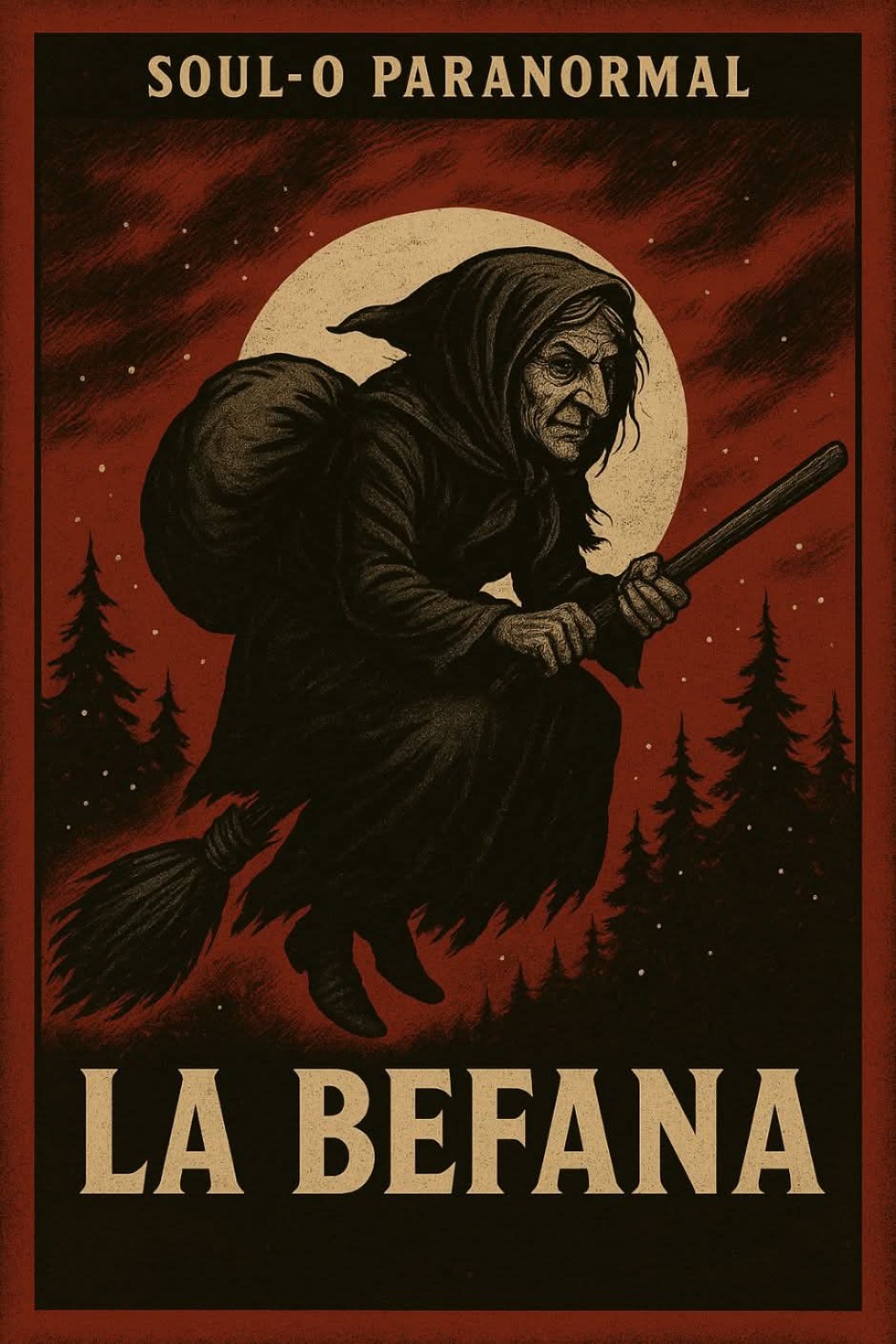
Italy’s Winter Wanderer
As the old year exhales its final breath and the new one waits in silence to be born, a shadow glides across the Italian skies. It is La Befana, the winter witch, neither fairy godmother nor fearsome hag, but something in between. Bent with age, wrapped in dark shawls, she rides a broomstick with a sack slung over her shoulder, her silhouette etched against the cold stars.
Her story reaches back to the thirteenth century, though her spirit is older still. She may have once been Strenia, the Roman goddess of purification and the New Year, honoured with gifts in January. As Christianity spread, the goddess faded, and in her place emerged a mortal woman, still bearing gifts, but now forever wandering.
Her night is January fifth, the eve of Epiphany. Children hang stockings by the hearth, hoping for sweets and toys if they have been good, or lumps of coal, now often black sugar candy, if they have strayed. In the morning, her presence lingers like a whisper, the scent of ashes, a scatter of sweets, a broom leaning quietly against the wall.
Folklore and Legend
One winter’s night, long ago, the Three Magi followed the star to Bethlehem and stopped at La Befana’s cottage. She welcomed them with warmth, offered food and shelter, and listened to their tale. At dawn, they invited her to join their journey to see the newborn Christ.
She declined. There was sweeping to do, bread to bake, chores that could not be left undone. But as the day wore on, regret crept in like a chill through a cracked door. She packed a sack with gifts, sweets, fruits, toys, and set off to find the child herself. She followed the star, wandered from village to village, but never reached Bethlehem.
Her legend branches into many paths. In some, angels bless her with a broom and the power to fly, allowing her to deliver gifts to children each year. In others, she is cursed to wander forever, punished for her hesitation. Yet every Epiphany Eve, she returns to the skies, slipping down chimneys, still searching for the child she missed.
In the quiet corners of rural Italy, her tale grows darker. Shepherds speak of a crone watching from the treeline, her shawls fluttering like wings. She is not cruel, but she is not entirely of this world. She stands at the threshold between years, between choices, between what was and what might have been.
Paranormal Reports
Today, La Befana is celebrated with joy and mischief. Bonfires blaze, street festivals erupt, and effigies of the old woman are burned to mark the end of winter and the promise of renewal. Yet beneath the laughter, the old stories remain.
Some families speak of soot footprints by the fireplace, too large and distinct to belong to anyone in the house. Others tell of brooms falling from their hooks in the night, or a faint scent, woodsmoke and herbs, drifting through locked rooms as midnight approaches.
In mountain towns and isolated farmhouses, there are whispers of a hunched figure seen in the snow, watching the windows of sleeping children. She is not a saint, nor a ghost, but something older. A spirit bound to the rhythm of winter and gift-giving, still wandering, still searching.
La Befana is the crone who missed her chance and turned it into a mission. She is the witch who knocks softly at your chimney, deciding if you are worthy of sweetness or coal.
If the Magi came to your door, would you follow the star, or stay behind to finish your sweeping?