
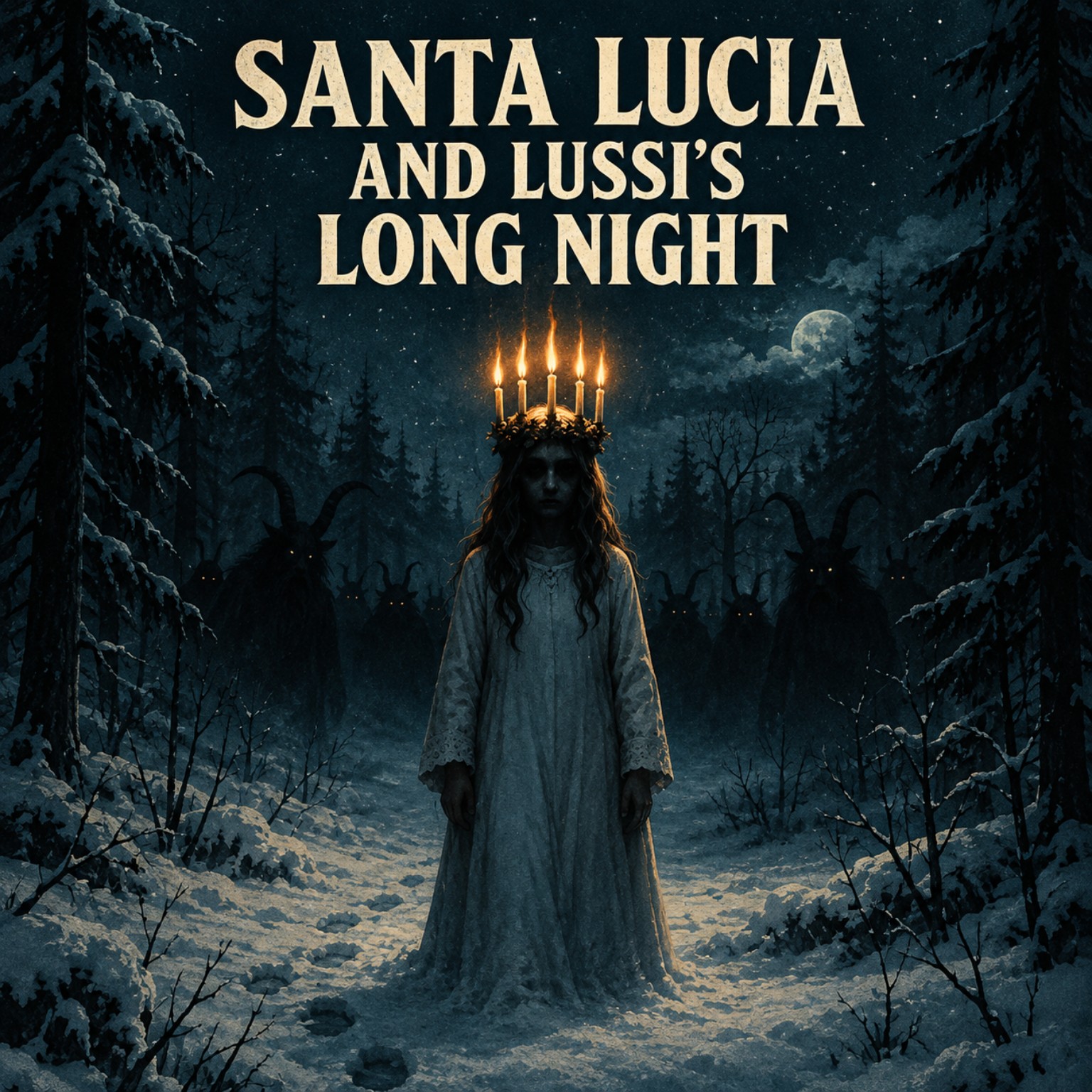
History
Santa Lucia, celebrated on the thirteenth of December, shines today as Sweden’s Festival of Light, yet her story begins far from the snowbound North. Lucia was a Christian martyr from Syracuse in Sicily, killed during the Roman persecutions in the early fourth century. Her name, rooted in lux, meaning light, made her a symbol of hope and spiritual vision.
Her cult travelled northward during the medieval era, carried by trade routes, monastic traditions, and seafaring pilgrims. By the eighteenth century, Swedish households near Lake Vänern had begun choosing a girl to appear before dawn on the thirteenth of December, dressed in white with a red sash and crowned with candles. She brought food, drink, and the promise of brighter days.
With the reforms of the Lutheran age, most saints vanished from Swedish tradition, but Lucia endured. Perhaps she survived because she arrived on the threshold of the darkest night, a moment when winter presses hardest against the windows. In the modern era, Lucia processions became public events, then national rituals, with candles, choirs, saffron buns, and the solemn hymn of Lucia turning the morning into a symbolic rebirth of light.
Yet the date itself is older than the Christian saint. Under the Julian calendar once used in the North, the thirteenth of December marked the winter solstice. Long before Lucia’s gentle glow, this night already carried the memory of fear.
Folklore
Before the Church’s Lucia, there was Lussi.
In the deep Norse past, the thirteenth of December was known as Lussinatta, or Lussi’s Night, also called Lussi Langnatte, the Long Night of Lussi. This was a dangerous hinge in the year when darkness reached its peak, the veil thinned, and winter spirits roamed freely.
Lussi herself was no saintly figure. In traditional lore she is a towering winter witch, a being of the wild, the feral, and the untamed. She rides the skies with her host, the Lussiferda, a spectral cavalcade echoing the pan-European Wild Hunt. Anyone found outdoors after dusk risked being swept up into her airborne procession or struck down by her passing.
Households kept strict rules. All spinning, weaving, and unfinished work had to be completed before the Long Night. If the home was disorderly, if chores lay undone, Lussi would peer down the chimney or through windows, punishing laziness with broken roofs, spoiled food, or vanished children. Livestock were carefully guarded, as trolls and winter spirits were said to walk abroad, emboldened by the solstice dark.
Even the beloved saffron buns called lussekatter carry a shadowed memory. Their name has often been tied to devil’s cats, a folklore motif in which a dark feline spirit beat misbehaving children while golden-colored buns were given to the good. The bright yellow saffron, the curled shapes, and the raisin eyes all served as edible charms to chase away the sinister forces prowling the night.
Modern Lucia processions, with white gowns, candle crowns, star boys, and tomten with lanterns, appear gentle and orderly, yet beneath them lies the echo of an older world. A world where the thirteenth of December was not a festival of light, but a night when light was desperately needed.
Paranormal Aftermath
To step into a Lucia celebration today is to walk across layers of belief, the martyr’s glow resting over the witch’s shadow, both resting over the ancient terror of the solstice.
For paranormal investigators, Lussi’s Night remains a charged moment.
Rural families across Sweden still speak of subtle disturbances around the thirteenth of December. Animals grow restless, staring into corners of barns as if sensing an unseen visitor. Children report vivid dreams of flying, rushing wind, or a great noise overhead, dreams that mirror old accounts of the wild winter procession. Elders remember ancestors who would never venture outside on this night and who warned that the Long Night punished the careless.
A Soul-O investigator walking a farmstead on Lucia’s Eve may feel the atmosphere deepen. Snow quiets the land, the air hangs still, and the cold carries a strange clarity. It becomes easy to imagine the sky open above you, vast and expectant, as if waiting for movement. The silence has weight, almost like breath held.
Folklore creates patterns, and patterns leave residue. When a community has feared, honoured, and ritualised a night for a thousand years, that charge settles into the soil. Whether one interprets it as ancestral memory, spiritual imprint, or collective unconscious, Lussinatta feels different. The threshold between the living and the unseen thins.
Modern Sweden may sing Lucia’s hymns to push back the dark, but in the quiet hours before dawn, when candles gutter and barns creak in the frost, the old stories whisper their reminder:
Light is only a visitor on this night, never the ruler, and Lussi’s shadow still knows its way home.