
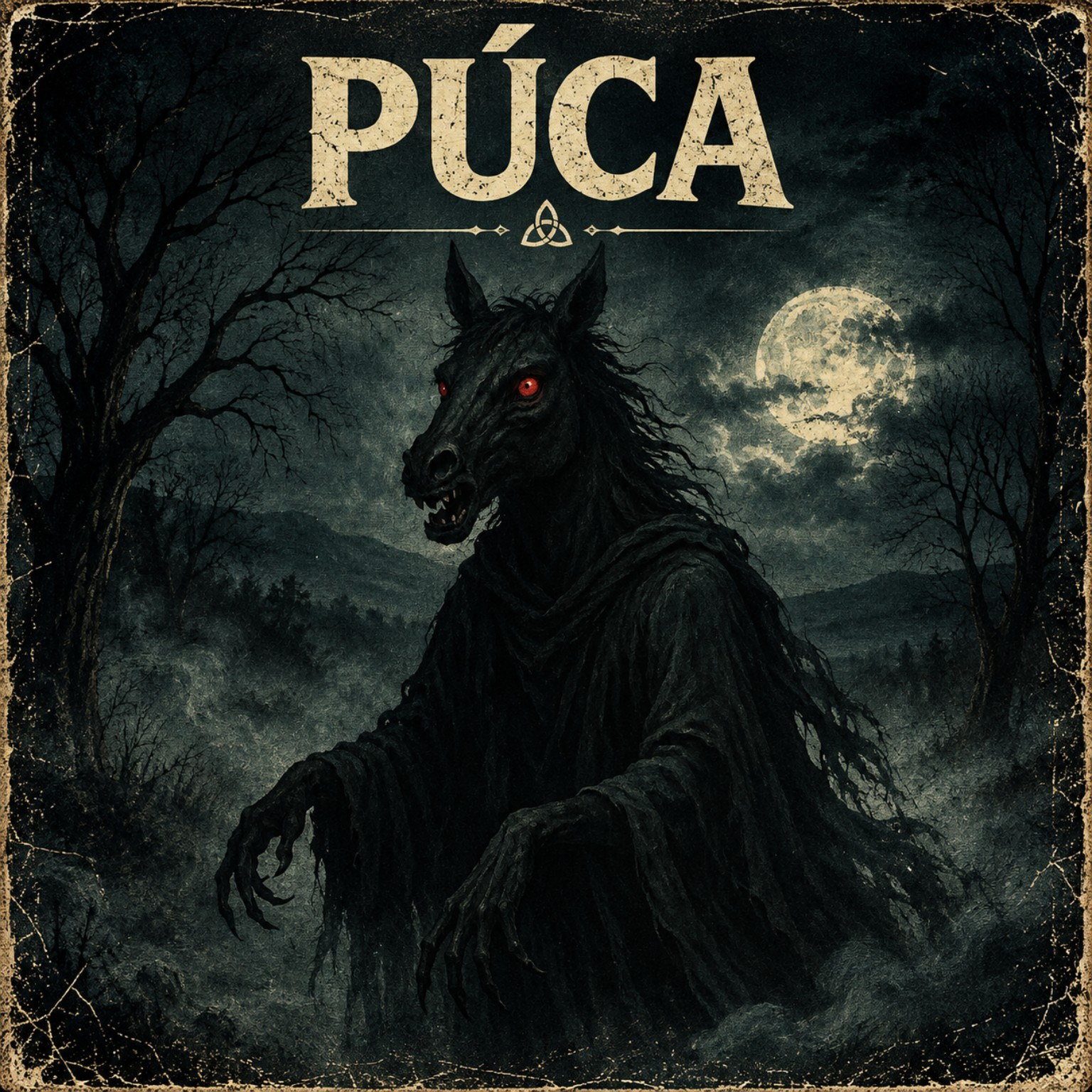
There are places in Ireland where the land seems to breathe differently, where crossroads lie quiet under a moonless sky and bridges echo with unseen steps. In those spaces, between the safe and the strange, the Púca waits.
The name Púca, also rendered Pooka or Phouka, has a disputed history. Older folk explanations sometimes linked it with the Irish poc, a he-goat, while linguistic scholarship has also connected it with words such as Old English puca and Old Norse púki. The uncertainty suits a being famous for refusing to keep one shape.
It may appear as a dark horse, a goat, a hare, a dog, a bird or a strange human-like figure. Across Irish tradition the details change from place to place, but the Púca remains unpredictable.
Travellers walking home late might find an animal standing in their path. In some stories, anyone foolish enough to mount the Púca in horse form is carried on a wild ride across fields, bogs and hills before being dumped back into the ordinary world exhausted and wiser than before.
While many stories paint the Púca as a malicious trickster, others give it a more complicated character. It can frighten, mislead or torment, but some traditions also associate it with prophecy, warnings and the fortunes of the harvest.
The Púca is particularly associated with Halloween and the beginning of November. Irish folklore records warnings against eating late berries after Halloween because the Púca was said to have spoiled or fouled them. Other traditions speak of leaving a share of the harvest for the Púca.
The Púca is not easily reduced to demon, ghost or guardian. It belongs to the uncertain edges of folklore, capable of good fortune and bad, warning and mischief, terror and laughter.
Even now, the old image survives: a silent horse at a crossroads, a hare watching from a wall, something moving just beyond the reach of the light. That is where the Púca belongs, in the spaces between certainty and myth, grinning in the dark.