
History: A Kingdom and a Curse
The kingdom of Ossory once stretched across what is now modern-day County Kilkenny and County Laois, at the heart of Ireland. Its kings and people shaped the early medieval story of the island, their lands lying between the rivers Nore and Barrow. But alongside the stone churches and monastic records, Ossory carried another legacy, a dark legend recorded in chronicles as early as the twelfth century.
Cleric and writer Gerald of Wales, in his Topographia Hibernica (1180s), described encounters with wolves who were not wolves at all, but men and women under a terrible curse. The tale would echo through centuries of Irish and European folklore, casting Ossory not just as a seat of kingship, but as the land of werewolves.
Folklore and Legend: The Wolves of Ossory
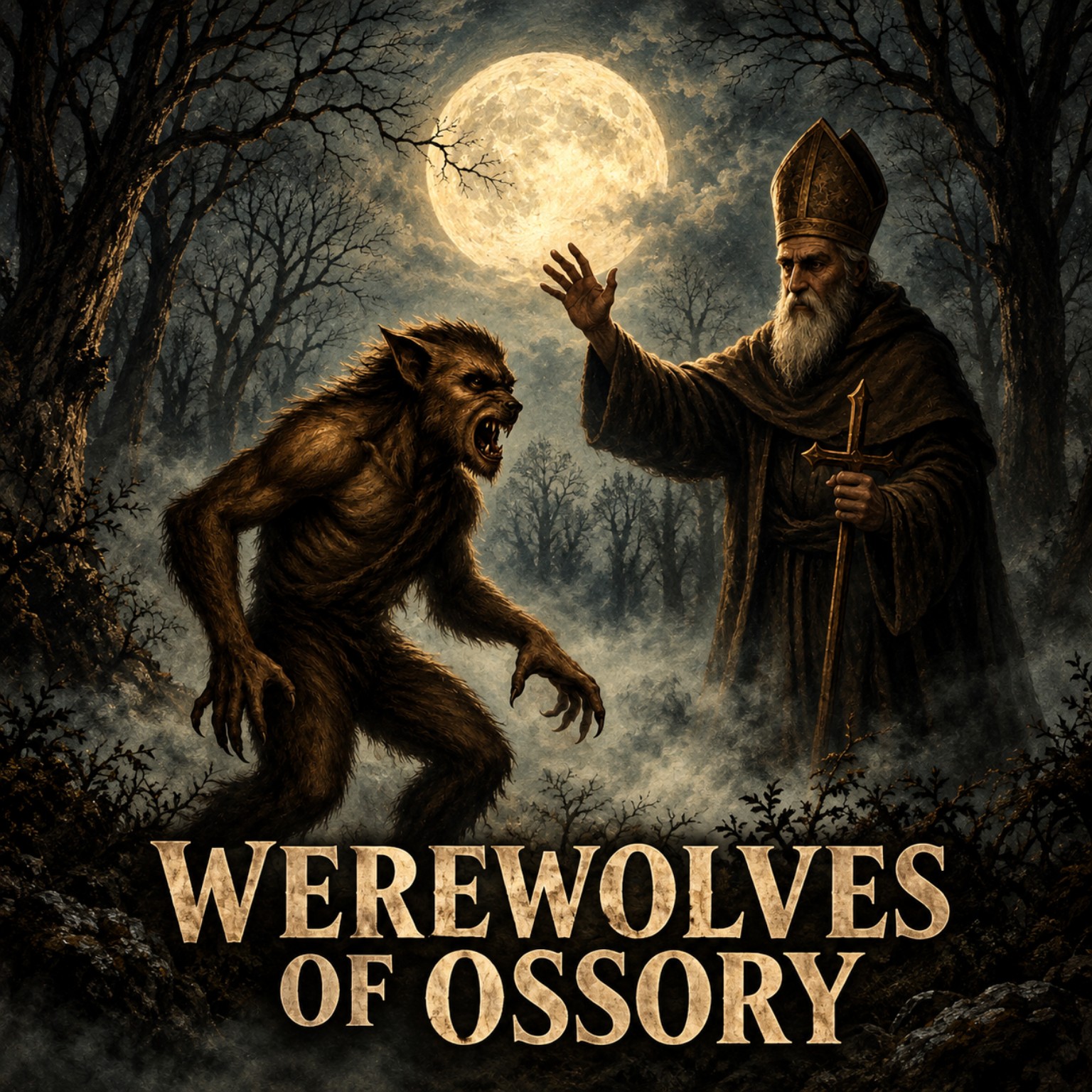
According to tradition, a clan in Ossory was cursed by a saint, some versions say St. Patrick, others say St. Natalis (Naile). The curse condemned them to live as wolves for seven years at a time. When the seven years ended, the spell passed to another member of the family, binding them to an endless cycle of transformation.
Unlike the bloodthirsty monsters of later European lore, the wolves of Ossory were described as tragic figures. They retained human souls, spoke like men, and carried the weight of their curse with sorrow.
Gerald of Wales recounts one chilling encounter: a priest was approached by a wolf who spoke Latin. The beast revealed himself as a man of Ossory and begged the priest to administer last rites to his dying wolf-wife. Pulling back the fur, the wolf showed that beneath the pelt was the body of a human woman.
This mingling of pagan shapeshifter tradition with Christian storytelling created a legend that was neither wholly beastly nor holy, but somewhere in between. The wolves of Ossory were not demons, nor ordinary men, but cursed souls walking the line between two worlds.
Paranormal Aftermath: Shadows of the Wolf
To this day, the werewolves of Ossory linger in Ireland’s supernatural imagination. Whispered in Halloween tales, they are seen not as villains but as mournful guardians of a cursed legacy.
Some folklorists suggest the Ossory wolves echo older Celtic beliefs in warrior-shapeshifters, men who could don wolfskins to take on feral strength in battle. Others see them as metaphors for exile and otherness, punished for sins we can no longer name.
Modern paranormal enthusiasts note that the regions of Kilkenny and Laois carry reports of eerie howls, phantom wolves, and spectral hunters roaming by night. In Irish storytelling, Ossory’s curse is eternal, the wolves pass from one generation to the next, never free, always waiting for the seventh year to come.
The land may have forgotten its kings, but its wolves still walk in story and shadow, Ireland’s oldest haunting, and perhaps its deepest terror.