
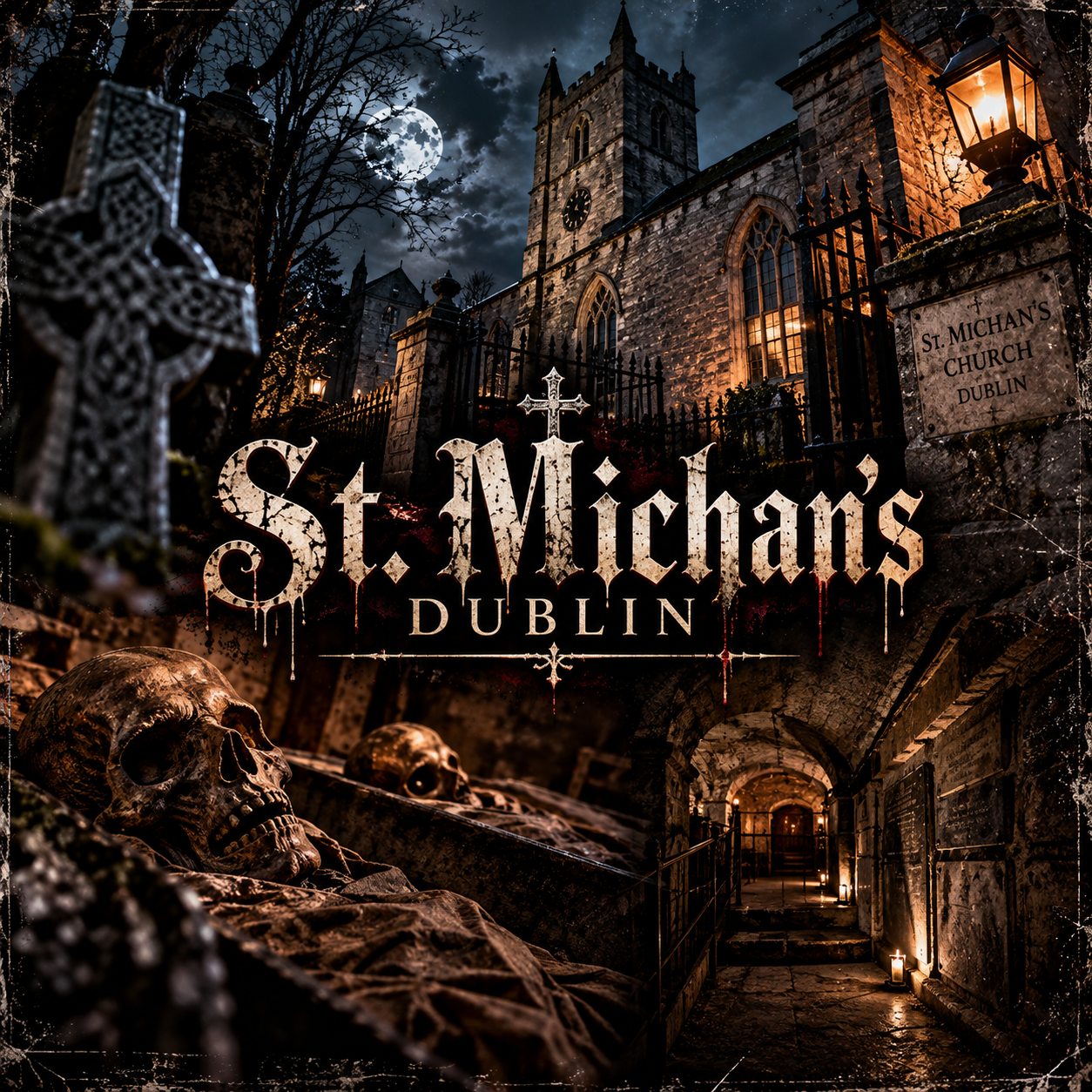
Hidden along Church Street in Dublin, St. Michan’s Church appears modest above ground. Yet beneath its limestone foundations lies a crypt where time stands still and the air hangs heavy with centuries. The original chapel dates as far back to 1095, surviving the Viking era. The current church was built in 1686 under architect William Robinson and later remodelled in 1825. Its organ is even believed to have trained Handel before his debut performance of Messiah.
Below the sanctuary, the crypt tells a darker story. The dry, methane rich air and limestone walls created ideal conditions for mummification. Among the preserved figures known as the “Big Four” is the Crusader, a towering skeleton said to have returned from the Holy Land, his arm raised in a silent gesture. Nearby rests the Thief, missing a hand and both feet, and the Nun, whose age is rumoured to exceed four hundred years. Their identities remain cloaked in mystery.
The vaults also hold the remains of Henry and John Sheares, revolutionaries executed in 1798, and several Earls of Leitrim, including one so despised that his family refused him a proper coffin.
Ghostly stirrings are as old as the stones. Visitors have reported soft voices drifting through the crypt, unseen hands brushing their shoulders, and the chilling sense that the dead are not merely resting they are watching.
In recent years, the silence was broken not by spirits but by desecration. In 2019, vandals entered the crypt, decapitated the Crusader, and stole skulls, an act so sacrilegious it made headlines across the country. Then, in June 2024, arson destroyed five more mummies in a fire that left their remains beyond repair, turning centuries of history into ash.
St. Michan’s crypt is not just a place of preservation. It is a confrontation with mortality. The candlelit forms remind us that death does not always bring peace. Beneath the calm surface of worship, the walls seem to whisper: You are not alone.
Would you descend into the vaults where Dublin’s past still breathes?