
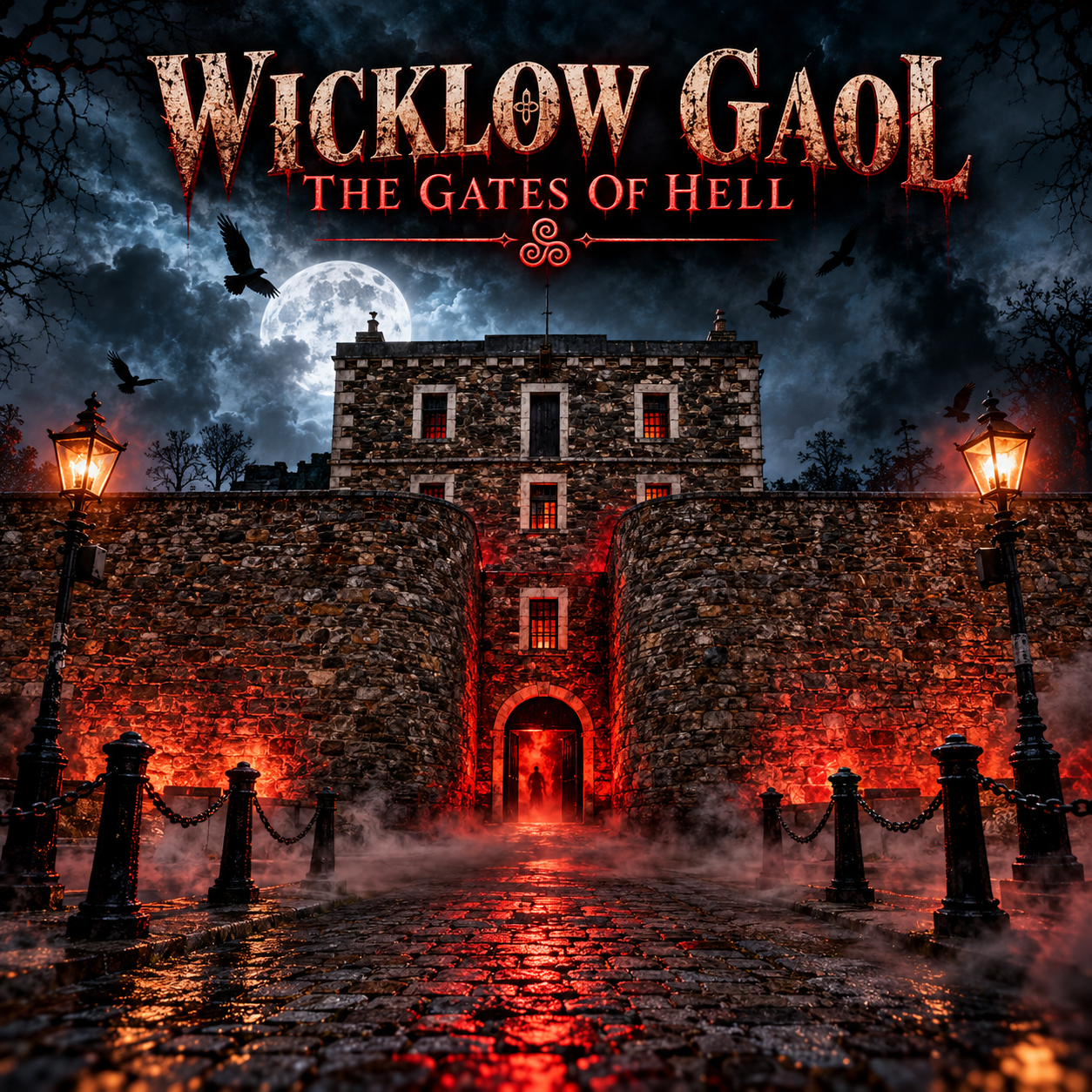
Introduction
Join John Ambrose Martin of Soul-o Xperience as he explores the dark history, enduring folklore, and reported hauntings of Wicklow Gaol, one of Ireland's most infamous prisons.
Perched high on Kilmantin Hill overlooking Wicklow Town, the gaol has witnessed more than three centuries of suffering, rebellion, punishment, and loss. Within its granite walls, rebels awaited transportation, famine victims endured desperate conditions, and condemned prisoners faced the gallows that stood above the entrance.
Locals gave it a chilling nickname that survives to this day:
The Gates of Hell.
For many who crossed its threshold, there was no return.
History: The Gates of Hell
A prison has stood on the site since 1702, though the imposing structure visitors see today largely dates from major expansions carried out during the nineteenth century under renowned architect William Vitruvius Morrison. The prison was enlarged in 1822 and again between 1842 and 1843 as overcrowding and prison reform transformed Ireland's penal system.
Over the centuries, Wicklow Gaol became intertwined with some of the most turbulent periods in Irish history.
During the 1798 Rebellion, rebel prisoners filled its cells before facing execution, exile, or transportation overseas. During the Great Famine, men, women, and children found themselves imprisoned for crimes born from desperation and poverty. The gaol later held prisoners during the Irish War of Independence and the Irish Civil War, including the famous Irish nationalist Erskine Childers.
Its reputation for harsh conditions became legendary.
Disease spread rapidly through overcrowded cells. Death was commonplace. Prisoners often awaited transportation to Australia, while others met their end beneath the gallows that stood above the prison entrance. Many passed through the gates never to see freedom again. The grim reputation earned the prison its enduring nickname:
The Gates of Hell.
The final prisoner left the gaol in 1924. Yet many believe not everyone ever truly departed.
Folklore: Spirits of the Cells
With generations of suffering compressed within its walls, it is little surprise that ghost stories soon followed.
Among the most frequently reported apparitions is a mysterious Woman in Black Velvet. Witnesses describe a darkly dressed female figure gliding silently through corridors before vanishing without a trace. She appears most often on the lower floors, where many prisoners once spent their final days.
Other tales speak of ghostly children heard crying within empty cell blocks. Some visitors report hearing laughter where no one is present. Others describe seeing young figures standing silently at the end of corridors before disappearing when approached.
The prison's most famous phenomenon may be the Green Mist.
Reports describe an unexplained green haze drifting through sections of the gaol. Witnesses claim the mist appears without warning, moving against air currents and lingering in areas associated with former prison cells. Some who have encountered it describe feelings of dizziness, unease, or overwhelming sadness.
Shadow figures are also regularly reported.
Dark silhouettes have been seen moving between cells, crossing corridors, and standing silently in doorways. One particularly active location is said to be Cell 19, where visitors have reported seeing a male figure emerge from the darkness before fading away moments later.
Whether these experiences are the product of suggestion, atmosphere, or something far stranger remains open to debate.
Paranormal Aftermath: When the Walls Remember
Wicklow Gaol has attracted paranormal investigators from around the world and featured on television programmes including Ghost Hunters International, whose team explored the prison's reputation as one of Ireland's most haunted locations.
Many visitors describe experiences that go beyond simple ghost stories.
Doors have reportedly opened on their own.
Footsteps have been heard echoing through empty wings.
Cold spots appear without explanation.
Some visitors report feeling watched, while others describe an oppressive atmosphere that seems to follow them through the building.
One recurring account tells of a tour conducted in near total darkness. During a period of silence, a nearby door slowly creaked open despite no one standing near it. Others present reported the unsettling sensation that the prison walls themselves were closing in around them.
Staff working within the gaol have shared stories of unexplained noises, movement witnessed out of the corner of the eye, and voices heard in empty sections of the building. Visitors entering certain cells speak of sudden emotional reactions, overwhelming sadness, or an urge to leave immediately.
For paranormal investigators, Wicklow Gaol offers something few locations can match.
The sheer weight of human suffering.
Generations of fear, punishment, grief, and despair have left their mark on these stone walls. Whether that history alone is enough to create such powerful experiences, or whether something of the past still lingers here, remains unanswered.
What is certain is that Wicklow Gaol continues to live up to its reputation.
Not merely as a prison museum.
But as a place where history refuses to stay silent.