
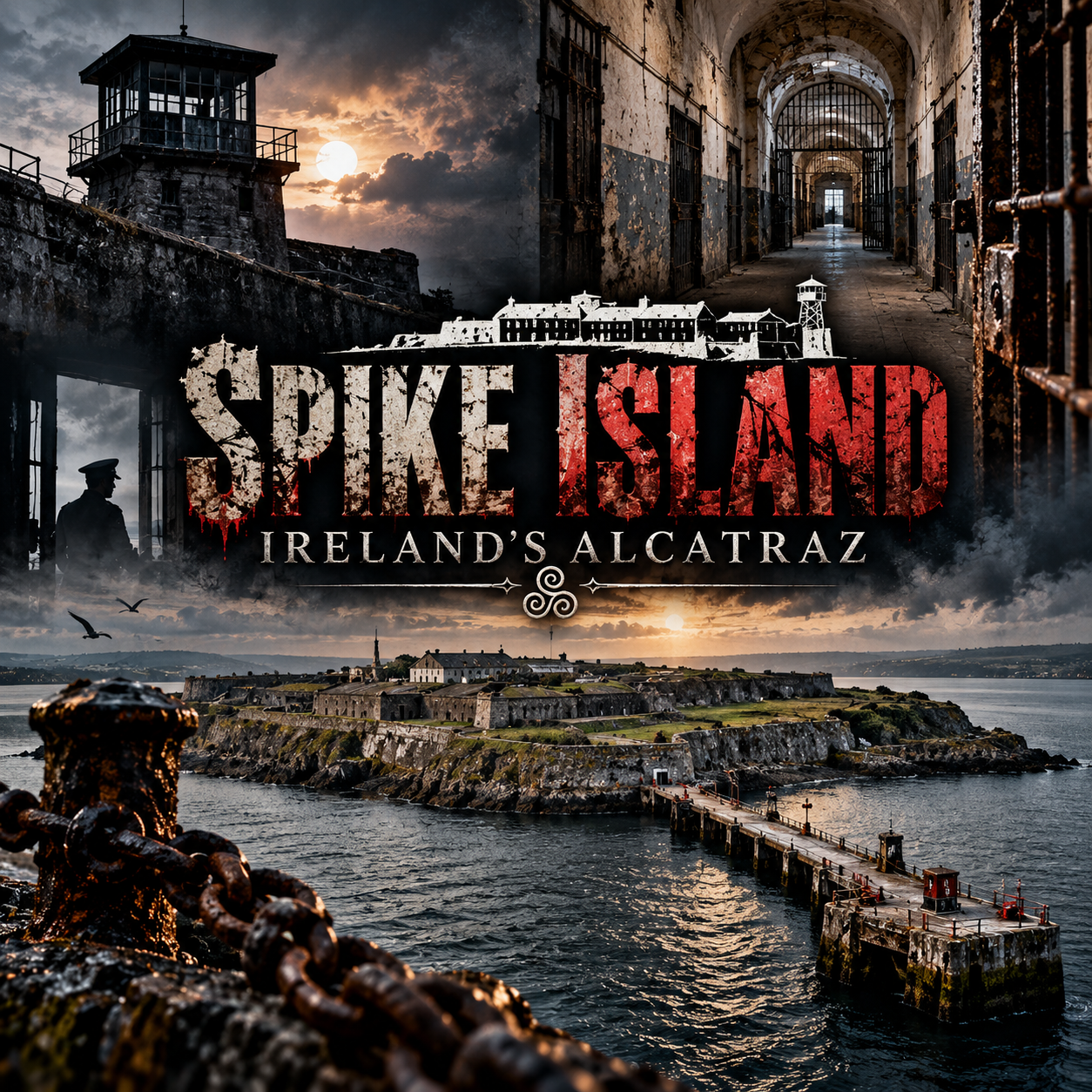
Off the coast of Cobh in County Cork lies Spike Island, a place where sacred beginnings gave way to centuries of suffering. Once home to a seventh century monastery founded by Saint Mochuda, the island was transformed in 1779 when the British constructed Fort Mitchel to guard Cork Harbour. Its walls, once built for protection, would soon become instruments of confinement.
In 1847, at the height of the Great Famine, Spike Island became a prison. Within months, it swelled to hold more than two thousand four hundred inmates, making it the largest prison in the world at the time. Disease and despair spread through the cells, and in just seven years, over one thousand prisoners died. Their bodies were buried in mass graves to the east of the island. Later, during the War of Independence, rebels and IRA detainees filled the same blocks, their voices silenced by stone and steel. Spike remained a working prison until 2004, its legacy an unbroken chain of suffering that spanned more than one hundred and fifty years.
Yet some who entered never truly left.
Today, Spike Island is known as Ireland’s Alcatraz, not only for its fortress prison past but for the spirits said to linger within its walls. Visitors speak of the White Woman, gliding silently through the corridors in a gown of spectral silk. Soldiers once claimed to have seen the Gaunt Gunner, a ghostly figure so vivid that rifles were raised against him.
One cell, Cell Nine, became infamous for its terror. Prisoners begged not to be locked inside, claiming unseen hands shoved them awake, blankets were torn away in the night, and sanity slipped with every scream. In the solitary tunnels, tourists and guides report shadows moving against the light, the sensation of being pushed, and voices whispering from the dark.
During an investigation by Soul-o Xperience, three encounters stood out.
The first was the sound of gunfire echoing across the island. Sharp and distinct, it rang out without warning. Yet when we searched for the source, there was none. Locals and staff had no explanation, and other teams, including television crews, have reported the same phantom shots.
The second occurred outside the old quarters where women and children were once held. On the gravel path, we heard footsteps approaching. When I went to investigate, the path was empty, the sound vanished, as though the steps had dissolved into the night.
The third came during a public investigation in the solitary confinement block. We conducted an Estes Method experiment. One person sat blindfolded in the cell, wearing isolation headphones connected to a spirit box, repeating anything they heard. Another person asked questions outside, unheard by the listener. Over the course of the night, with multiple pairs of strangers rotating through the cell, we received corroborated responses. Names were repeated by different people, direct answers matched the questions, and full messages emerged. These were participants who had never met, yet the patterns aligned. The solitary block seemed alive with voices reaching out across the divide.
Spike Island has worn many masks, monastery, fortress, prison, tourist attraction. But its truest face is one carved by pain. Each stone seems to breathe with the weight of the lives it has swallowed. And sometimes, in the dark, it answers back.
Would you board the ferry and spend a night inside Ireland’s Alcatraz?